Why Do I Look Better in the Mirror Than in Photos?
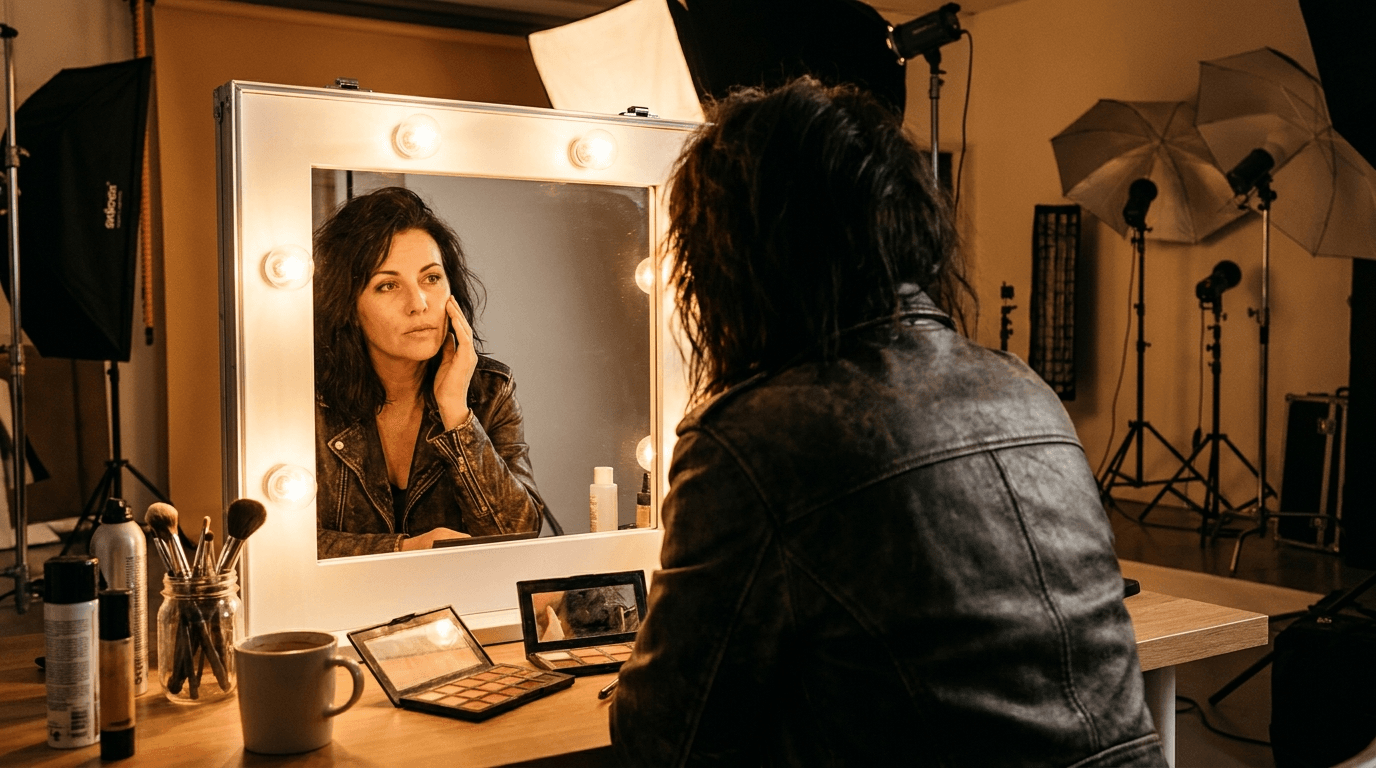
Why the camera can make you look unfamiliar – and why neither your mirror nor a photograph is the complete truth
There is a sentence I have heard in my studio more times than I can count:
“I like the way I look in the mirror. I just don’t like myself in photographs.”
Sometimes it comes from someone who considers themselves photogenic. Sometimes it comes from someone who has avoided cameras for years. But the feeling behind it is remarkably common.
And the more years I’ve spent photographing faces, the more interesting I’ve found the question.
Why can you look into a mirror in the morning and feel completely comfortable with the person looking back at you – then see a photograph taken later that day and think:
Is that really what I look like?
The easy answer is that mirrors reverse your face.
That’s true.
But it’s only the beginning.
There are actually several things happening at once involving psychology, facial asymmetry, perspective, movement, depth, familiarity and the way our brains construct an image of ourselves.
And perhaps the most important point is this:
A photograph is not necessarily a more truthful version of you than a mirror.
They are simply two very different ways of seeing a human face.
First: You Have Spent Your Entire Life Learning Your Mirror Face
Unless you’re an actor, model, broadcaster or someone who spends an unusual amount of time looking at photographs and video of yourself, the version of your face you know most intimately is probably the one in the mirror.
And that version is reversed.
Raise your right hand and the person in the mirror appears to raise the hand on your left.
The difference seems trivial until you remember something important:
Human faces aren’t perfectly symmetrical.
One eyebrow may sit slightly higher than the other. One eye may open a little more. The corners of the mouth may rise differently. Your jaw may be subtly stronger on one side.
None of these things are flaws. They’re normal characteristics of a human face.
But after seeing one orientation of those characteristics thousands of times, your brain becomes extremely familiar with it.
Then someone takes a photograph.
Suddenly your face is flipped into the orientation that everyone else normally sees.
Your features haven’t changed.
Your familiarity with them has.
Psychologists have studied this phenomenon for decades. In experiments involving people’s preferences for normal and mirror-reversed photographs, people often show a preference for the familiar mirrored orientation of their own face.
Interestingly, friends tend to show the opposite preference.
That makes sense.
You know your mirror face. Your friends know your real-world face.
So when someone looks at a photograph and says, “That doesn’t look like me,” they may not really mean the photograph is inaccurate.
Their brain may be saying:
“That isn’t the version of me I recognize most easily.”
Those are two very different things.
But There’s Something Even Stranger Happening
When you look into a mirror, you aren’t looking at a photograph.
You’re looking at a live performance.
And you’re both the performer and the director.
Tilt your chin slightly.
Change your posture.
Relax your mouth.
Lift your eyebrows.
Turn your head two degrees.
Move closer.
Move farther away.
Smile.
Stop smiling.
You may not consciously think about any of these adjustments, but the feedback loop is continuous.
You see yourself.
You react.
Your expression changes.
You see the change.
You react again.
This can happen in fractions of a second.
A photograph removes that entire feedback system.
The camera does not care whether you were halfway between two expressions when the shutter fired.
It simply records that fraction of a second.
And that distinction matters more than most people realize.
Nobody Experiences You as a Frozen Photograph
Think about the last conversation you had with someone.
Did you stare at their face completely motionless?
Of course not.
Their eyes moved.
Their mouth moved.
Their head turned.
Their expressions came and went.
Their posture shifted.
They smiled, listened, reacted and spoke.
This constant movement is part of how we recognize and experience another person.
There is even research into something known as the “frozen face effect.”
Researchers have found that people can appear more flattering or attractive when viewed naturally in motion than when observers are shown individual still frames taken from that same footage.
That’s fascinating because the photograph isn’t necessarily bad.
It’s simply incomplete.
Imagine recording someone talking for ten seconds.
Within those ten seconds there may be hundreds of tiny transitional expressions.
Freeze exactly the wrong millisecond and you might capture something that nobody standing in front of that person would ever consciously notice.
That’s one of the strange responsibilities of portrait photography.
We are trying to represent a moving human being with one frozen frame.
That is much harder than simply recording what someone looks like.
Your Brain Isn’t a Camera Either
There’s another assumption worth questioning:
That somewhere inside our brain exists a perfectly objective photograph of ourselves.
There doesn’t seem to be.
Human perception doesn’t work like a hard drive storing untouched JPEG files.
Our brains interpret.
They prioritize.
They compare.
They remember.
They predict.
They combine what we’re seeing now with everything we’ve seen before.
And research into self-perception suggests that our mental representation of our own appearance isn’t necessarily perfectly objective.
In one particularly interesting experiment, researchers created slightly altered versions of participants’ faces – some made more attractive and some less attractive.
Participants were sometimes quicker to recognize subtly enhanced versions of themselves as their own face.
Think about what that suggests.
Our internal idea of “what I look like” may not simply be a neutral recording.
It may be a reconstruction.
And that reconstruction can contain some bias.
This is more scientifically defensible than saying we literally “blur out” the things about ourselves we don’t like.
Our eyes aren’t applying Photoshop’s blur tool to our wrinkles.
But our perception absolutely isn’t neutral.
That distinction matters.
Your Bathroom Mirror May Also Have an Optical Advantage Over Your Phone
Now we move from psychology into optics.
And this is where things get especially interesting.
Imagine you’re standing two feet away from a flat mirror.
The reflected image of your face appears approximately two feet behind the mirror.
That means your eyes perceive the reflected face at an optical distance of roughly four feet.
Now compare that with a selfie.
Most people hold their phones somewhere around a foot or two from their face.
That difference in distance can dramatically change facial proportions.
The closer a camera moves toward a face, the larger the closest features appear relative to features farther away.
And what is usually closest to the camera?
Your nose.
Move the camera back and those proportions begin to normalize.
There has even been published research modeling how close-distance smartphone photography exaggerates features such as the nose.
So when someone says:
“My nose looks huge in selfies.”
They may not be imagining it.
The camera position can genuinely be creating that appearance.
This is also why photographers tend to be careful about camera-to-subject distance when shooting headshots. It’s one of the first things experienced headshot photographers in Los Angeles control before a single frame is taken.
People often attribute this entirely to the lens:
“An 85mm lens makes people look better.”
That’s not quite the whole story.
Perspective is primarily determined by camera position.
A longer lens allows a photographer to move farther away while still framing a tight headshot.
That additional distance is what produces more natural facial proportions.
The lens and distance work together.
A Photograph Also Turns a Three-Dimensional Person Into a Flat Surface
There is another fundamental difference between seeing someone in person and seeing their photograph.
You’re three-dimensional.
A photograph isn’t.
When someone stands in front of you, your visual system is processing depth.
Your nose projects forward.
Your eyes sit farther back.
Your cheekbones, jaw, forehead, ears and neck all occupy different positions in space.
As you move your head, those spatial relationships continually change.
Then a camera takes all of that depth and compresses it onto a two-dimensional rectangle.
A skilled portrait photographer therefore has to create the illusion of dimensionality using other tools:
- light
- shadow
- camera position
- head angle
- body position
- lens choice
- focal distance
- background separation
- expression
This is one reason lighting matters so much in portraiture.
Great lighting isn’t simply about making someone “brighter.”
Light describes shape.
It tells the viewer where the cheekbone ends.
It defines the jaw.
It creates depth around the eyes.
It separates the face from the background.
Good portrait lighting is essentially using a two-dimensional medium to convince your brain that you’re looking at a three-dimensional person.
So Which Is More Accurate: The Mirror or the Camera?
This is probably the question most people actually want answered.
Neither one is completely accurate.
The mirror gives you:
- movement
- immediate feedback
- familiar orientation
- depth cues
- continuously changing expressions
But it reverses your face.
A photograph gives you:
- the orientation other people normally see
- a permanent record of one instant
- no live feedback
- no movement
- a two-dimensional interpretation
- whatever perspective the camera position created
And real life gives people something else entirely:
you.
Moving.
Talking.
Listening.
Reacting.
Laughing.
Turning your head.
Making eye contact.
Existing in three dimensions.
Other people don’t walk around experiencing you as your driver’s-license photograph.
And they don’t experience you as your bathroom mirror either.
Why You May Be the Worst Person to Choose Your Own Best Photograph
Here’s another part of the psychology that I find fascinating as a photographer.
We tend to assume that because nobody knows our face better than we do, we should automatically be the best person to select our own photographs.
Research suggests that isn’t always the case.
Studies involving social-media profile photographs have found situations where photographs selected by other people created better first impressions than photographs people selected themselves.
At first this sounds ridiculous.
Who could possibly know your face better than you?
But that’s exactly the problem.
You know it too well.
You may reject an otherwise fantastic photograph because:
“My left eyebrow looks strange.”
Meanwhile, nobody else notices the eyebrow.
They’re looking at your expression.
Confidence.
Warmth.
Intelligence.
Approachability.
Strength.
Maybe you love another photograph because the position of your jaw looks especially familiar to you.
But someone who doesn’t know you isn’t comparing your jaw against thirty years of mirror memories.
They’re simply responding to the person in the picture.
This happens constantly during headshot sessions.
A photographer and a client can look at the exact same photograph and initially see completely different things.
Neither person is necessarily wrong.
They’re simply evaluating the image from different psychological perspectives.
This Is Why Being “Photogenic” Is More Complicated Than People Think
I don’t really believe that people divide neatly into two groups:
photogenic people and unphotogenic people.
Photography is far too dependent on circumstances for that.
Change the camera distance.
Change the angle.
Change the lighting.
Change the expression.
Change the posture.
Change the moment the shutter fires.
You can create a completely different photograph of the same person seconds later.
I’ve photographed people who walked into the studio convinced that they simply didn’t photograph well.
Usually what they’re describing isn’t an inherent characteristic of their face.
They’re describing their history with photographs.
Bad selfies.
Unflattering phone lenses.
Awkward school pictures.
Someone taking photographs from six inches below their chin.
Being photographed while uncomfortable.
Being told to “smile” and suddenly producing an expression they would never naturally make.
After enough experiences like that, people begin creating an identity around them:
“I’m just not photogenic.”
I think that’s usually the wrong conclusion.
The Real Job of a Headshot Photographer
This is where portrait photography becomes much more interesting to me than simply owning an expensive camera.
A camera is exceptionally good at recording information.
But information alone doesn’t necessarily produce a good portrait.
The real challenge is:
How do you take a moving, expressive, three-dimensional person and translate them into one still, two-dimensional frame that actually feels like them?
That’s where direction matters.
Lighting matters.
Camera distance matters.
Timing matters.
Conversation matters.
And perhaps most importantly, making someone comfortable enough to stop performing for the camera matters.
I don’t want the expression someone thinks they’re supposed to make when they’re having their photograph taken.
I want to get beyond that.
Because somewhere underneath the “camera face” is the expression that their friends, family, clients, casting directors or coworkers actually recognize.
That’s usually the photograph we’re looking for.
If You Hate Photographs of Yourself, Consider This
The next time you see a photograph and immediately think:
“Oh my God. Is that what I really look like?”
Don’t automatically assume you’ve just discovered some terrible truth the mirror has been hiding from you.
Ask better questions.
Was the camera extremely close?
Was the photograph taken at an awkward angle?
Were you halfway through an expression?
Were you uncomfortable?
Was the lighting poor?
Are you simply seeing the non-mirrored orientation of your face and interpreting unfamiliarity as unattractiveness?
Are you analyzing tiny details nobody else would ever notice?
Because there is no single objective image that represents what you look like.
Not the mirror.
Not a selfie.
Not a driver’s-license photo.
Not one bad photograph somebody took at dinner.
A human face isn’t static.
Neither is a human being.
And perhaps that’s the biggest misconception created by photography.
We’re trying to judge something alive from something frozen.
The Goal Isn’t to Make You Look Like Someone Else
Good headshot photography isn’t about hiding every wrinkle, changing the shape of your face or transforming you into some idealized version of yourself.
In my opinion, that’s missing the point.
The goal is to create a photograph where you look at the image and recognize something beyond individual features.
You recognize yourself.
And equally important, someone who knows you should be able to look at that same photograph and say:
“That’s you.”
When both of those things happen at the same time, we’ve probably made a very good headshot.
Frequently Asked Questions
Why do I look better in the mirror than in pictures?
You are more familiar with your mirror-reversed face, and a mirror also shows you continuously moving while giving you immediate visual feedback. A photograph freezes one fraction of a second, presents your face in its non-reversed orientation and can alter apparent proportions depending on camera distance and angle.
Is the mirror or camera more accurate?
Neither perfectly represents how other people experience you. A mirror reverses your face but shows movement and depth. A photograph shows your normal orientation but freezes one moment and converts a three-dimensional subject into a two-dimensional image.
Is a selfie what I really look like?
Not necessarily. Close camera distances can exaggerate facial proportions, particularly features closest to the lens such as the nose. A professionally photographed portrait is generally made from considerably farther away.
Why does my face look asymmetrical in photos?
Every human face has some degree of asymmetry. Because you are accustomed to seeing your face reversed in a mirror, seeing those asymmetries in their normal orientation can initially feel strange.
Why do I hate photos of myself?
Familiarity, facial asymmetry, camera distance, frozen expressions, lighting, pose and self-perception can all contribute. Disliking a photograph doesn’t necessarily mean the photograph revealed how everyone else sees you.
Do other people think I look like my photographs?
Other people are accustomed to your face in its non-mirrored orientation, but they normally experience you moving, talking and expressing yourself in three dimensions. A still photograph represents only one small part of that experience.
Final Thought
After years of photographing people, I’ve become convinced that one of the biggest mistakes we make is assuming the camera is an objective judge.
It isn’t.
It’s a tool.
Put it too close and it changes perspective.
Catch the wrong fraction of a second and it freezes an expression nobody noticed.
Light a face poorly and it changes how its structure is perceived.
Put that same camera in the right position, use the right light, give someone meaningful direction and capture the right moment – and suddenly the photograph feels completely different.
The person didn’t change.
The photograph did.
And that may be the most important thing to remember the next time you look at a picture of yourself and wonder why it doesn’t look like the person you know in the mirror.